
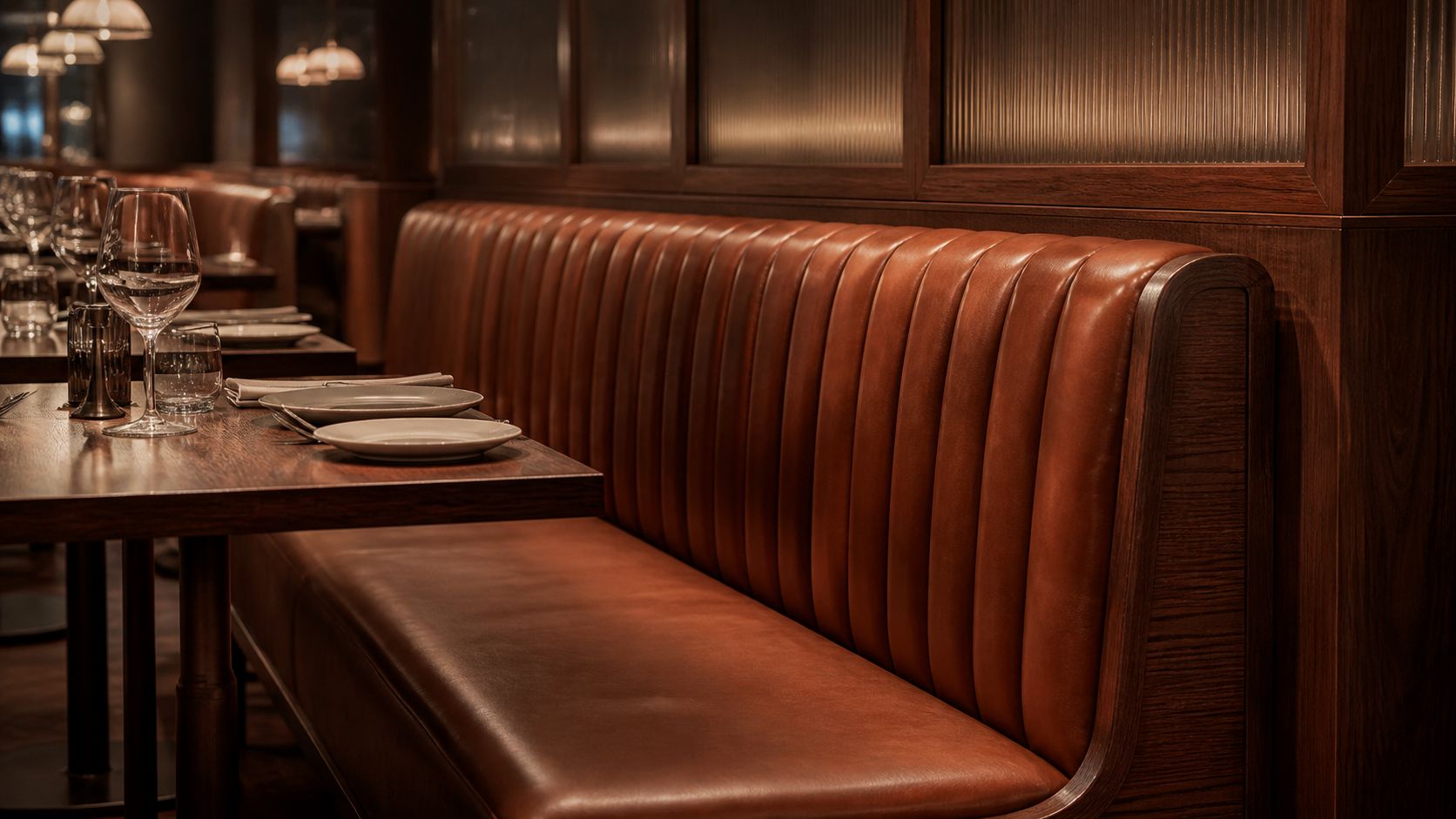
Bespoke upholstery for a high-traffic London restaurant should be specified around service conditions, not appearance alone. Banquettes, booths, benches and dining chairs may face repeated use, spillages, cleaning and contact with tables, walls or circulation routes. The brief should explain where each seat will be used and what the operator expects from it.
This creates a clearer basis for selecting upholstery materials and coordinating them with the surrounding joinery. It also helps designers avoid universal specifications that sound robust but do not account for the actual product, supplier guidance or maintenance regime.
Describe How the Restaurant Seating Will Be Used
Start with the operating pattern. Record the expected level of use, typical sitting duration, type of food and drink service, cleaning routine and areas most exposed to queues or circulation. A waiting bench near an entrance has a different role from a deep booth intended for longer dining.
Comfort also depends on the relationship between seat height, depth, back angle, table position and available legroom. These dimensions should be developed as one arrangement and tested against the intended dining experience. Where possible, review a representative sample or first-off seat before releasing a larger quantity.
A Practical Upholstery Brief Should Record
- The seating location, quantity and intended pattern of use.
- The approved dimensions and relationship with tables and circulation.
- The selected fabric, leather or coated material and supplier reference.
- Required performance evidence identified by the project team.
- Cleaning instructions, replacement strategy and approval sample.
Assess the Complete Seating Build-Up
The appropriate frame, suspension, cushioning and cover depend on the seating design and required use. No single timber species, fixing method or foam specification is automatically correct for every restaurant. The manufacturer should develop the build-up for the approved design and provide relevant product information where the project requires it.
Fire-performance requirements should come from the project specification and be supported by evidence applicable to the proposed materials and use. They should not be inferred from a generic description such as “commercial grade”. If a component changes after approval, the responsible project party should review whether the existing evidence still applies.
Estetiko provides bespoke upholstery, furniture and joinery services, including custom banquettes, booths and benches. Its guide to integrating joinery and upholstery explains why the hard and soft elements should be developed together.
Compare Fabric Evidence with the Maintenance Plan
Abrasion-test results can help compare fabrics, but one number should not decide the specification. Seams, surface texture, colour, light exposure, stain behaviour and the way a material responds to the operator’s cleaning products can all affect suitability. Ask the supplier what the stated test result covers and whether the material is recommended for the proposed setting.
A coated fabric, woven textile or leather may each be appropriate in a different part of the restaurant. None should be described as maintenance-free or universally easy to clean without checking the supplier’s care instructions. Strong chemicals or an unsuitable cleaning method can damage a surface even when it is intended for commercial use.
Review larger samples under the restaurant lighting and alongside the joinery finishes. The article on material selection for high-traffic environments provides a broader framework, while Estetiko’s upholstery guide for designers covers the wider briefing process.
Coordinate Fixed Seating with the Joinery Package
Fixed banquettes often meet wall panelling, plinths, dividers, tables, sockets or floor finishes. Drawings should show these interfaces and identify which dimensions are confirmed on site. Removable pads or panels may help future access, but their locations and fixing method should be resolved during design rather than improvised during installation.
Developing the joinery and upholstery within one coordinated package can reduce handover points between trades. It does not remove the need for approvals, supplier evidence or site checks; it gives the team one set of coordinated drawings and samples against which those decisions can be recorded.
Specify Restaurant Upholstery with Evidence
A useful restaurant-seating brief connects guest comfort and visual intent with real service, cleaning and maintenance conditions. Samples, supplier information and coordinated drawings then allow the project team to approve a build-up suited to the particular location.
Share the seating plan, design references and operational requirements with Estetiko to discuss a coordinated upholstery and joinery package.
