
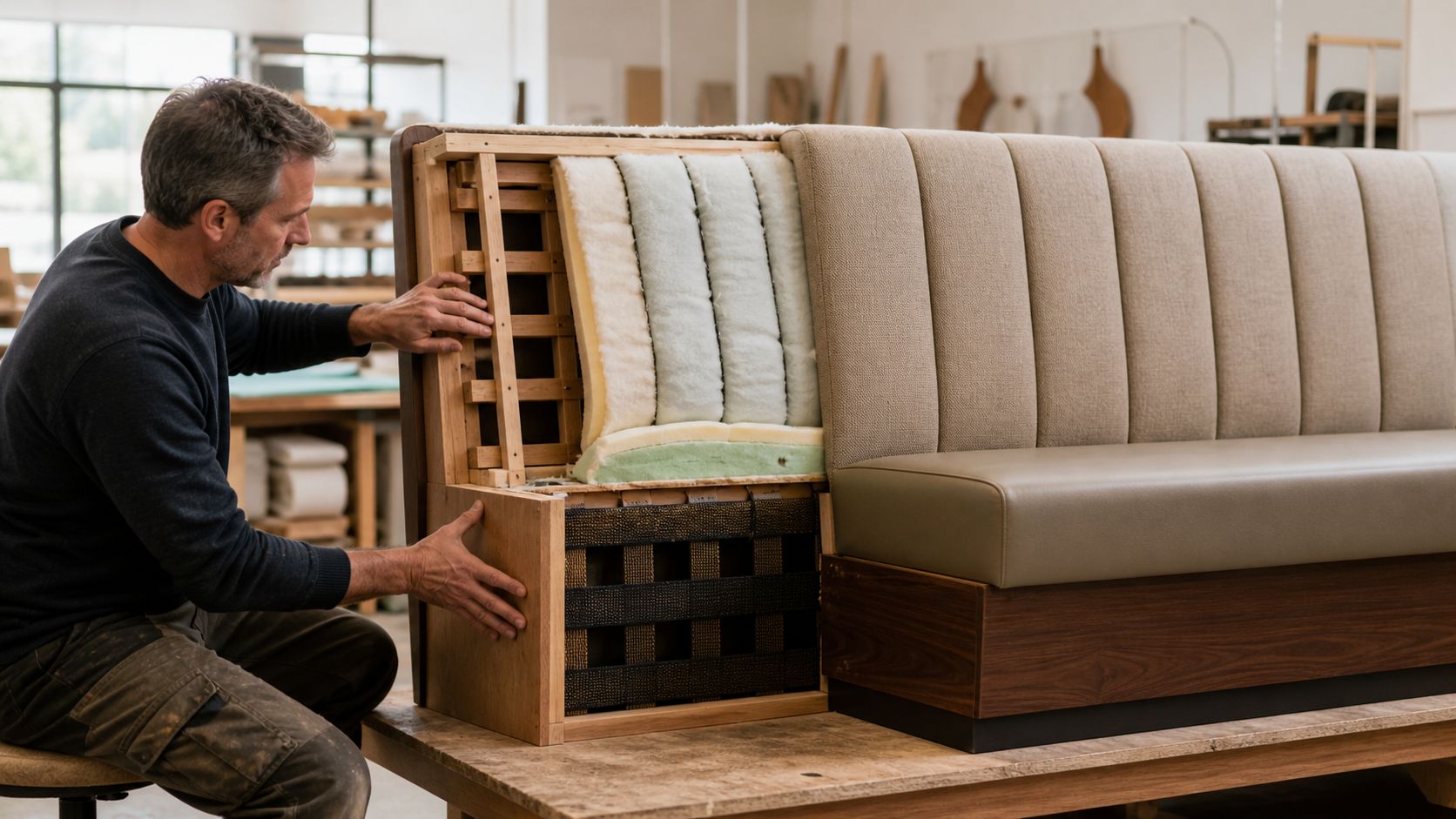
The right choice is rarely based on worn fabric alone. Commercial seating reupholstery is worth considering when the underlying construction suits the new brief and the seating can remain in its present location. Replacement becomes the stronger route when frames, support, dimensions or layout no longer work. Some projects benefit from a hybrid: retain sound elements and remake the parts that need a different form or function.
For hospitality, retail, workplace and leisure operators, that decision affects more than appearance. Facilities, design and procurement teams need to compare what exists with the future layout, intended use, material palette, access arrangements and project programme. A structured survey gives that comparison a reliable starting point.
Start with the Frame, Not the Fabric
Upholstery can conceal much of a seat’s construction, so surface wear does not reveal the whole picture. Before choosing a route, inspect the frame, joints, support layers, loose components and attachment points. For a fixed banquette, also establish how the unit meets walls, flooring, skirtings and adjacent joinery.
Record damage and movement by unit rather than treating a long seating run as one item. An assessment can then distinguish cosmetic wear from construction that needs further investigation. Any judgement about whether an existing frame is suitable should follow an inspection of that specific seating.
A Quick Decision Test
Ask three questions in order: Is the existing construction appropriate to retain? Does the current footprint support the proposed layout? Can the new design and operational brief be achieved without remaking the unit? The answers point towards reupholstery, replacement or a mixed scope; they do not replace a detailed assessment.
When Reupholstery Fits the Brief
Reupholstery is a credible option when the seating’s frame and format remain appropriate, while the covering, cushioning or detailing needs renewal. It can suit a banquette that already fits its alcove, a booth whose proportions remain useful, or loose seating that the design team wants to retain within a refreshed scheme.
The scope should state what will be stripped, retained, renewed and refinished. Photographs, dimensions, quantities and access notes help a specialist understand the starting point. Estetiko’s commercial upholstery and reupholstery services include refurbishment of existing furniture as well as custom banquettes, booths, benches and soft seating.
When Replacement Gives the Brief More Freedom
Replacement deserves consideration when the layout is changing, the dimensions no longer suit the space, or the desired design cannot be achieved sensibly with the existing construction. It may also be the clearer path when a survey identifies widespread issues across frames, joints, support or attachments.
New manufacture allows the seating to be developed around a revised plan, a different visual language or new interfaces with walls and cabinetry. That does not automatically make replacement the better financial or programme choice. Quotes should compare like-for-like scopes, including removal, workshop work, manufacture, delivery, installation and any dependencies on other trades.
Compare Both Routes Against the Same Criteria
- Appearance: Can the retained form support the intended profile, seams, colours and finishes?
- Design freedom: Are seat lengths, curves, divisions or surrounding elements changing?
- Programme: When can seating be removed, assessed, worked on, delivered and installed?
- Budget: Are all enabling works and interfaces included in each scope?
Use the comparison to expose unknowns. A provisional assumption about concealed construction should be identified as such rather than presented as a settled outcome.
A Hybrid Scope Can Resolve an Uneven Starting Point
Commercial seating often varies across a venue. One run may remain suitable while another conflicts with a revised entrance, service route or table plan. A hybrid scope can reupholster selected units, replace others and introduce new sections where the layout changes. This avoids forcing one answer onto seating with different conditions and roles.
Consistency then depends on coordination. The team should agree profiles, fabric direction, seam positions, visible joinery and finish references across retained and new work. Examples of commercial interior projects can help stakeholders discuss how seating relates to the wider setting rather than reviewing it as an isolated object.
Resolve Fabric, Cushioning and Joinery Together
Fabric selection should follow the actual commercial usage, cleaning approach, desired handle and visual brief. The guide to material selection for high-traffic environments provides a useful companion when turning those needs into a material discussion. Cushioning and upholstery build-up should also be considered in relation to the existing or proposed frame rather than specified independently.
On integrated seating, small changes can affect junctions with plinths, panels, tables or cabinetry. Planning these relationships as one package is the subject of Estetiko’s article on integrating joinery and upholstery. Drawings, samples and agreed interface details give the team a shared reference before workshop work begins.
Turn the Assessment into a Deliverable Scope
Estetiko can review the brief, seating types, material direction and joinery interfaces, then develop a proposal around the agreed route. Because the company provides upholstery, furniture and joinery, retained, replacement and integrated elements can be considered together. The delivery plan can then identify survey information, decisions, workshop work and installation coordination relevant to the project.
Review Your Commercial Seating Options
Share the existing seating information, proposed layout and design brief with Estetiko. The team can help define which elements should be assessed for reupholstery and where replacement or a hybrid scope warrants consideration.
A clear brief makes it easier to compare the options on the same basis and coordinate upholstery with any adjoining joinery.
